How we work,
across every offer.
Whichever offer you start with (Training, Audit & Consulting, or Build & Run), the engagement runs on one discipline and ends the same way: your team owns the AI and runs it without us. Below is how that plays out, from the shared method to the four deliberate phases of a production build.
One path to
AI autonomy.
The three offers are rungs of one ladder. You can step on at any rung; the discipline behind each is the same, and the endpoint never changes: your team masters the AI in-house.
Training gets your people fluent (Understand). Audit & Consulting tells you where AI is worth it and where it isn't (Decide). Build & Run designs, ships, and operates the AI itself (Implement → Operate). Whatever the rung, three habits run through every engagement: we scope before we act, we lead with evidence over opinion, and we leave artifacts you own, vendor-portable, with no dependency on SDEN baked into the next step.
That is what 'autonomy' means here. We are not optimizing for a long retainer; we are optimizing for the day you no longer need us. The more we work together, the less you depend on us, and every deliverable, from a training recording to a production codebase, is written to be picked up by your team without us in the room.
- 01
Understand
Your teams get fluent in AI, its risks, and its limits.
- 02
Decide
You learn where AI is worth it, where it's risky, and what to do first.
- 03
Implement
We design, build, and ship the AI into production.
- 04
Operate
We run it with you, then hand it over. You own it.
The Build & Run method,
phase by phase.
When the work is to build and operate AI in production, here is exactly how it runs: four deliberate phases, each ending in artifacts you own, plus the engineering disciplines that keep the system honest and free of debt.
Scoping & architecture
Phase one produces a concrete decision: build, buy, or do not start. SDEN delivers the architecture, the risk register, and a go / no-go recommendation (including whether AI is even the right tool) before any production code is written.
Scoping at SDEN is not a discovery call. It is a structured investigation that produces a written problem statement naming the actual job the software has to do, an architecture and decision log explaining the technical choices we recommend (and the alternatives we considered), and a risk register that ranks what could go wrong by exploitability and business impact. For AI work it goes further: an honest feasibility read (is this a problem a model can solve reliably, or is it a rules engine wearing an AI costume?), a build-versus-buy call against off-the-shelf options, and a look at whether your data is actually ready to feed a model. The phase ends with a go / no-go we are willing to stand behind in front of your board.
We ask the questions other vendors skip. Who is the accountable decision-maker on your side? What does the work look like for the user the day after launch, not at the demo? What data does the product create, where does it live, and who is allowed to see it, and where does it sit under the EU AI Act's risk tiers? Above all: what does 'good' mean, measured? We define the eval criteria here, in phase one, so 'it works' is a number we agreed on rather than a vibe at the demo. The phase is paid, time-boxed, and short, typically one to three weeks depending on scope.
What this phase produces
- Written problem statement with measurable success and eval criteria
- Architecture diagram + decision log (ADRs), including the build-vs-buy and 'AI vs not' call
- Risk register ranked by exploitability and business impact, with EU AI Act classification where it applies
- Data-readiness read for any AI use case (sources, quality, access, retention)
- Go / no-go recommendation, with the scope we would commit to
Rituals we keep
- One stakeholder interview per accountable decision-maker on your side
- Architecture review with the engineers who would build the project
- Mid-phase checkpoint with a draft of the artifacts
- Final phase review where we present the go / no-go recommendation
What we refuse during this phase
- We will not skip scoping because 'we already know what we want.' We have rescued enough projects to know that statement is rarely true.
- We will not recommend AI where a simpler tool wins. If a script, a rule, or an off-the-shelf product solves it, that is what the go / no-go will say.
- We will not write production code in this phase. Anything we ship here is a thought-prototype, clearly marked as throwaway.

Design & prototyping
Phase two turns the scoping decision into something you can validate before commitment: a real prototype against real data, with the model and architecture choices made on the record.
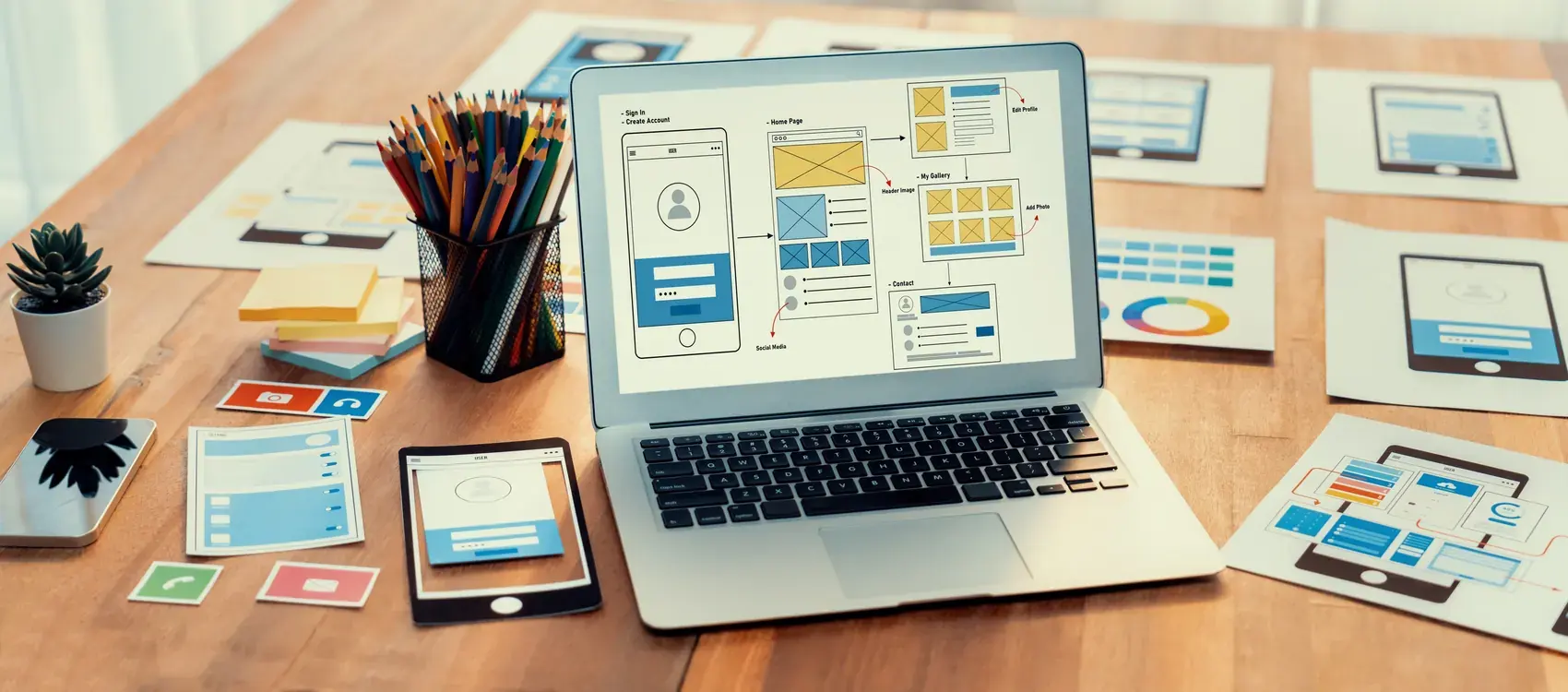
A demo is a video. A prototype is something the user can actually use, against the actual data shape, on the actual stack we will ship to production. Phase two delivers the latter. The team designs the core flows, builds an interactive prototype for the highest-risk paths (the ones that decide whether the product is usable, not the ones that decide whether it is pretty), and validates them against real data and real users before any production code lands.
For AI, this is where the consequential choices are made and written down: which model, and why; retrieval (RAG) versus fine-tuning versus a plain prompt; a single call versus an agent; and the cost and latency budget each path has to live inside. We bias toward boring tech under the AI (frameworks, databases, and hosting the community has already debugged at scale) and we name the reason for every choice. The phase also designs the eval harness: the graded test set that will tell us, automatically and on every change, whether the AI is getting better or worse. It produces the prototype, a design system (tokens, components, accessibility baseline), and that eval/test plan for the production phase.
What this phase produces
- Interactive prototype of the highest-risk flows, running on real data
- Model and architecture decision (model choice, RAG / fine-tune / agent) with written rationale (ADRs)
- An eval harness: a graded test set and the metrics production will measure on every change
- Cost and latency budget per AI path, named up front
- Design system (tokens, components, accessibility baseline)
Rituals we keep
- Two user-testing sessions on the prototype before phase three begins
- Weekly design review with engineering in the room
- Mid-phase stakeholder demo of the live prototype
- End-of-phase walkthrough of the test plan
What we refuse during this phase
- We will not present a prototype that mocks the failure paths. If the demo breaks when the user makes a mistake, the prototype is incomplete.
- We will not pick the biggest model by reflex. The default is the smallest model that passes the evals inside the cost and latency budget.
- We will not pick a stack because it is trending. The default answer is the boring stack that the team can still maintain in three years.
Development & hardening
Phase three turns the validated prototype into production-grade software: in short iterations, with code review on every change, security built in from the design stage, and no technical debt left behind.
Development at SDEN runs in two-week iterations with a working build at the end of every one. Every pull request is reviewed by a second engineer before merge; the merge gate runs the test suite, the eval suite from phase two, the security scanners (SCA, SAST, secret scanning), and the type checker. Branch protection is on, signed commits are on, and no engineer (including the most senior) can bypass the checks. The result is a codebase where the second engineer to read any file already understands it, and where a change that quietly makes the AI worse fails CI instead of reaching production.
Hardening is the part most vendors skip. It is the work that turns 'it runs' into 'it runs in production for the next three years.' For AI that means guardrails on inputs and outputs, cost ceilings so a runaway loop cannot bankrupt the feature, and a security review against prompt injection and the OWASP LLM Top 10 alongside the OWASP Top 10 and the relevant ASVS level. It also means load testing against expected traffic shapes, chaos testing the failure modes the risk register flagged in phase one, and the no-technical-debt clause: we will not ship code we would not be willing to take a 2 a.m. page on. If a deadline forces a shortcut, the shortcut lands in the issue tracker as a P0 and gets paid back before the next feature lands. We document the discipline explicitly in our security engineering posture.
What this phase produces
- Production-grade application in your repositories, deployed to staging
- Test and eval suites covering success paths, error paths, edge cases, and AI quality
- Guardrails and cost ceilings wired in (input/output checks, spend limits)
- Security review against the OWASP Top 10, the OWASP LLM Top 10, and the relevant ASVS level
- Load and chaos test results against the documented traffic shapes
Rituals we keep
- Two-week iteration cadence with a working build at the end of each
- Weekly demo to the client stakeholder, live on staging
- Code review on every PR, no exceptions
- End-of-iteration retrospective with the engineering team
What we refuse during this phase
- We will not bypass the merge checks under deadline pressure. If the check is wrong, the check is the bug.
- We will not ship an AI feature that fails its own evals, or one with no guardrails or cost ceiling. 'It looked fine in the demo' is not a release criterion.
- We will not ship code with a known unmitigated high-severity vulnerability. The vulnerability gets fixed; the deadline gets renegotiated honestly.
Delivery & support
Phase four is a controlled production release with the operational artifacts a team needs to run the software (and the AI inside it) once SDEN's role tapers: runbook, monitoring, SLOs, on-call playbook.
Delivery is staged. The first production release lands behind a feature flag for a single tenant or a small user cohort. We watch the SLOs (and, for AI, the quality and cost numbers) against real production traffic for a defined observation window, then expand to the full audience once the data confirms the system behaves as expected. The release is not a calendar event. It is a measurable state change.
What we hand over with the release is what makes the engagement durable: a runbook for every operational task, a monitoring dashboard that exposes the SLOs we committed to plus the AI's behavior in production (quality, drift, hallucination rate, and spend, not just uptime), an on-call playbook for the incidents the risk register anticipated, an incident response template, and documentation written for the next engineer who joins your team. Crucially, the handover transfers the AI itself: the prompts, the eval suite, and the guardrails, so your team can change the system safely, not just keep it running. SDEN engagements do not end at production. They taper. We commit to a defined support window after launch (usually three to six months, scoped to the engagement) during which we operate the system jointly with your team, and during which the operational knowledge transfers, not just the code.
What this phase produces
- Staged production release with feature-flag rollout
- Operational runbook for every routine production task
- Monitoring of SLOs and AI behavior: quality, drift, hallucination rate, and cost
- On-call playbook for the incidents the risk register anticipated
- Handover of the prompts, evals, and guardrails, with documentation for the next engineer
Rituals we keep
- Pre-release readiness review against the published checklist
- Staged rollout with documented expansion criteria
- Joint on-call rotation during the support window
- Monthly review of the SLO data during the support window
What we refuse during this phase
- We will not declare a release 'live' before the SLOs have been observed against real traffic.
- We will not abandon the team at handover. The handover is a defined process, not an email with a ZIP attached.

Approach:
questions about engagement.
Direct answers to the questions we get asked the most. If yours isn't covered, write to the team.